Name Assigned
A name is given at birth.
Psychology
Have you ever looked at someone and thought, 'They look like a Sarah' or 'He looks like a Michael'?
Research suggests that people can match names to faces better than chance. There is something about the way we look that fits our names.
The science of name-face matching is a growing field. Here is what researchers have discovered.
Quick Answer
Does my name match my face? Research suggests that to some degree, yes. People can match names to faces better than chance. This is known as the name-face matching effect. It is believed to be driven by social stereotypes and self-fulfilling prophecies. However, the effect is modest and not universal.
Quick Overview
Does my name match my face? Research suggests that to some degree, yes. People can match names to faces better than chance.
This is known as the name-face matching effect. It is believed to be driven by social stereotypes and self-fulfilling prophecies. However, the effect is modest and not universal.
Visual Guide
How names and faces become associated.
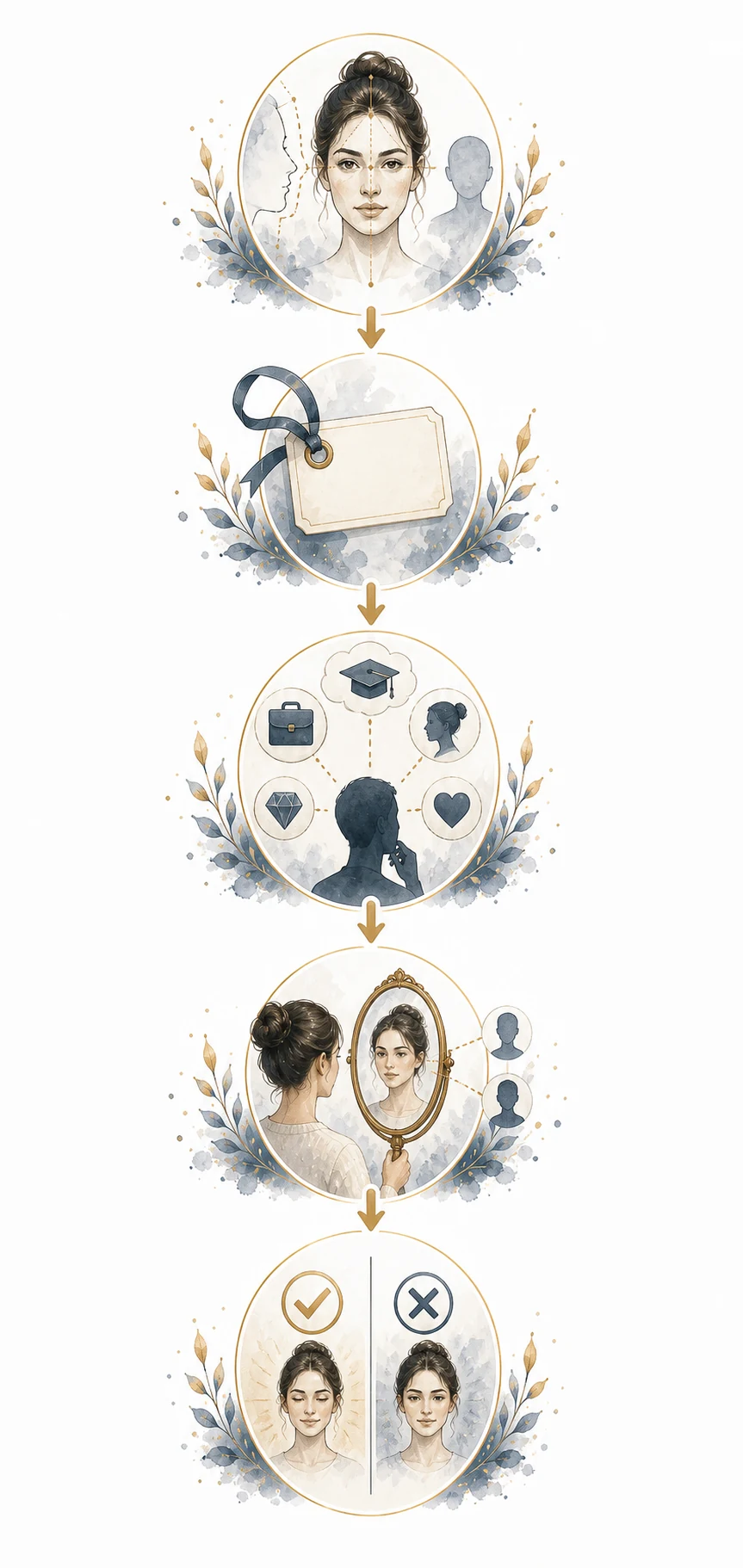
A name is given at birth.
Stereotypes are associated with the name.
Appearance aligns with expectations.
People can match name to face.
The name-face matching effect is the phenomenon where people can match names to faces better than chance.
In research studies, participants are shown a face and given a list of names. They are asked to choose which name belongs to the face. Participants consistently perform better than chance.
This suggests that there is something about the way we look that fits our names. The effect is not perfect, but it is statistically significant.
The effect is believed to be driven by social stereotypes and self-fulfilling prophecies.
The name-face matching effect is believed to work through several mechanisms.
First, social stereotypes play a role. Certain names are associated with certain traits. For example, names like 'Grace' are associated with elegance. Names like 'Rock' are associated with strength.
Second, self-fulfilling prophecies may shape appearance. If people expect someone named 'Grace' to be graceful, they may treat them in ways that encourage graceful behavior. This can affect posture, expression and even facial muscle development.
Third, cultural associations matter. Names that are common in certain cultures may be associated with certain facial characteristics.
Fourth, the effect may be driven by unconscious biases. People may not realize they are making associations.
Academic Study
Academic Study
Academic Study
Academic Study
Academic Study
| Name Type | Example | Matching Accuracy |
|---|---|---|
| Virtue Names | Grace, Faith, Hope | Higher accuracy |
| Strength Names | Rock, Max, Rex | Higher accuracy |
| Common Names | John, Mary, Sarah | Moderate accuracy |
| Unusual Names | Unique, rare names | Variable accuracy |
| Neutral Names | Chris, Taylor, Alex | Lower accuracy |
Your face perfectly matches your name.
The effect is modest. People match names to faces better than chance, but it is not perfect.
Everyone can match names to faces.
Some people are better at it than others. The effect is not universal.
Name-face matching is a new discovery.
The phenomenon has been studied for decades by psychologists.
Your name determines your appearance.
Names can influence appearance through self-fulfilling prophecies, but genetics are more important.
Important
Does my name match my face? Research suggests there is a connection. But it is not deterministic. Your name can influence how you are perceived and treated, which can shape your appearance over time.
Verdict
People can match names to faces better than chance. The effect is driven by social stereotypes and self-fulfilling prophecies. However, the effect is modest and not universal.
The question of whether your name matches your face reveals something about how society works.
Names carry expectations. Those expectations can shape how people see us and how we see ourselves.
The name-face matching effect is a reminder of the power of social perception. We are not just passive recipients of names. Names actively shape how we are seen.
What does that tell us? That names are not just labels. They are signals that carry meaning. And that meaning can shape not just how others see us, but how we appear.
Research suggests that to some degree, yes. People can match names to faces better than chance through the name-face matching effect.
The name-face matching effect is the phenomenon where people can match names to faces better than chance. It is driven by social stereotypes and self-fulfilling prophecies.
Some people are better at it than others. The effect is not universal.
No. Names can influence appearance through self-fulfilling prophecies, but genetics are more important.
Virtue names like Grace and Faith, and strength names like Rock and Rex, tend to have higher matching accuracy.
Does my name match my face? Research says there is a connection. Your name carries expectations. And those expectations can shape how you are seen. But you are more than your name. You are more than how others see you.